
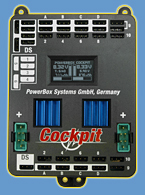
PowerBox Cockpit
3 695 SEK/styck
- Betala säkert med kort
- Maila oss, vi svarar snabbt!
- Snabba leveranser
- Öppet i butik och telefon mellan 9-18 Vardagar samt 10-15 (OBS Ny tid) på Lördagar*, ring +46 (0) 303-776303
* Vi kan vara upptagna, ring igen om vi inte svarar!
- VarumärkePowerBox
Beskrivning
Art.nr: MD_4610
Features:
High resolution graphical OLED screen with 128x64 pixels
Programming procedure using the SensorSwitch in conjunction with the OLED screen
11 channels + 1 channel for the door sequenzer
Signal amplification for a total of 11 channels and 21 servos
4 match channels
Double regulated output voltage
Energy consumption, voltage- and residual capacity display in mAh for both batteries
Sockets for telemetry bus systems Multiplex MSB and Spektrum
Data feedback by downlink - i.e. for data such as voltage, consumption and residual capacity for both batteries
Selectable servo voltage of 5,9V or 7,4V
Minimum value memory displays voltage collapses in flight
Large area heat-sink area for heat dissipation and even higher performance
Supports three battery types: NiMh/NiCd, LiFePo
Suppression of servo feedback currents
Specification:
Operating voltage: 4,0 Volts to 9,0 Volts
Power source:
2 x two-cell LiPO batteries 7,4 Volts
2 x five-cell NiCd or. NiMH batteries
2 x two-cell LiFePo batteries 6,6 Volts (A123)
Current drain:
Power-on state approx. 130 mA
Power-off state approx. 15 µA
Dropout voltage: approx. 0,25 V
Max. receiver- and servocurrent:
2 x 10 A (stabilised), according to efficiency of cooling
Peak 2 x 20 A
Servo signal resolution: 0,5µs
Signal frame rate:
User variable: 9ms, 12ms, 15ms, 18ms, 21ms
Screen: OLED 128 x 64 pixels, graphic
Bus systems: Spektrum, Multiplex
Servo sockets: 21 sockets, 11 channels, 4 of them match-channels,
single-channel door sequencer with 6 servo sockets
Temperature range: - 30 °C to + 75 °C
Dimensions: 110 x 72 x 24 mm (incl. base plate)
Weight: 115 g
SensorSwitch: 15 g
EMV approval: EN 55014-1:2006
CE approval: 2004/108/EG
High resolution graphical OLED screen with 128x64 pixels
Programming procedure using the SensorSwitch in conjunction with the OLED screen
11 channels + 1 channel for the door sequenzer
Signal amplification for a total of 11 channels and 21 servos
4 match channels
Double regulated output voltage
Energy consumption, voltage- and residual capacity display in mAh for both batteries
Sockets for telemetry bus systems Multiplex MSB and Spektrum
Data feedback by downlink - i.e. for data such as voltage, consumption and residual capacity for both batteries
Selectable servo voltage of 5,9V or 7,4V
Minimum value memory displays voltage collapses in flight
Large area heat-sink area for heat dissipation and even higher performance
Supports three battery types: NiMh/NiCd, LiFePo
Suppression of servo feedback currents
Specification:
Operating voltage: 4,0 Volts to 9,0 Volts
Power source:
2 x two-cell LiPO batteries 7,4 Volts
2 x five-cell NiCd or. NiMH batteries
2 x two-cell LiFePo batteries 6,6 Volts (A123)
Current drain:
Power-on state approx. 130 mA
Power-off state approx. 15 µA
Dropout voltage: approx. 0,25 V
Max. receiver- and servocurrent:
2 x 10 A (stabilised), according to efficiency of cooling
Peak 2 x 20 A
Servo signal resolution: 0,5µs
Signal frame rate:
User variable: 9ms, 12ms, 15ms, 18ms, 21ms
Screen: OLED 128 x 64 pixels, graphic
Bus systems: Spektrum, Multiplex
Servo sockets: 21 sockets, 11 channels, 4 of them match-channels,
single-channel door sequencer with 6 servo sockets
Temperature range: - 30 °C to + 75 °C
Dimensions: 110 x 72 x 24 mm (incl. base plate)
Weight: 115 g
SensorSwitch: 15 g
EMV approval: EN 55014-1:2006
CE approval: 2004/108/EG
Filer och media
 | Manual |